Business problem
PrimeCare needed a cleaner way to manage caregiver files, patient-related records, onboarding paperwork, expiring documents, and audit preparation without relying on paper folders and spreadsheet checks.

Home-care compliance platform
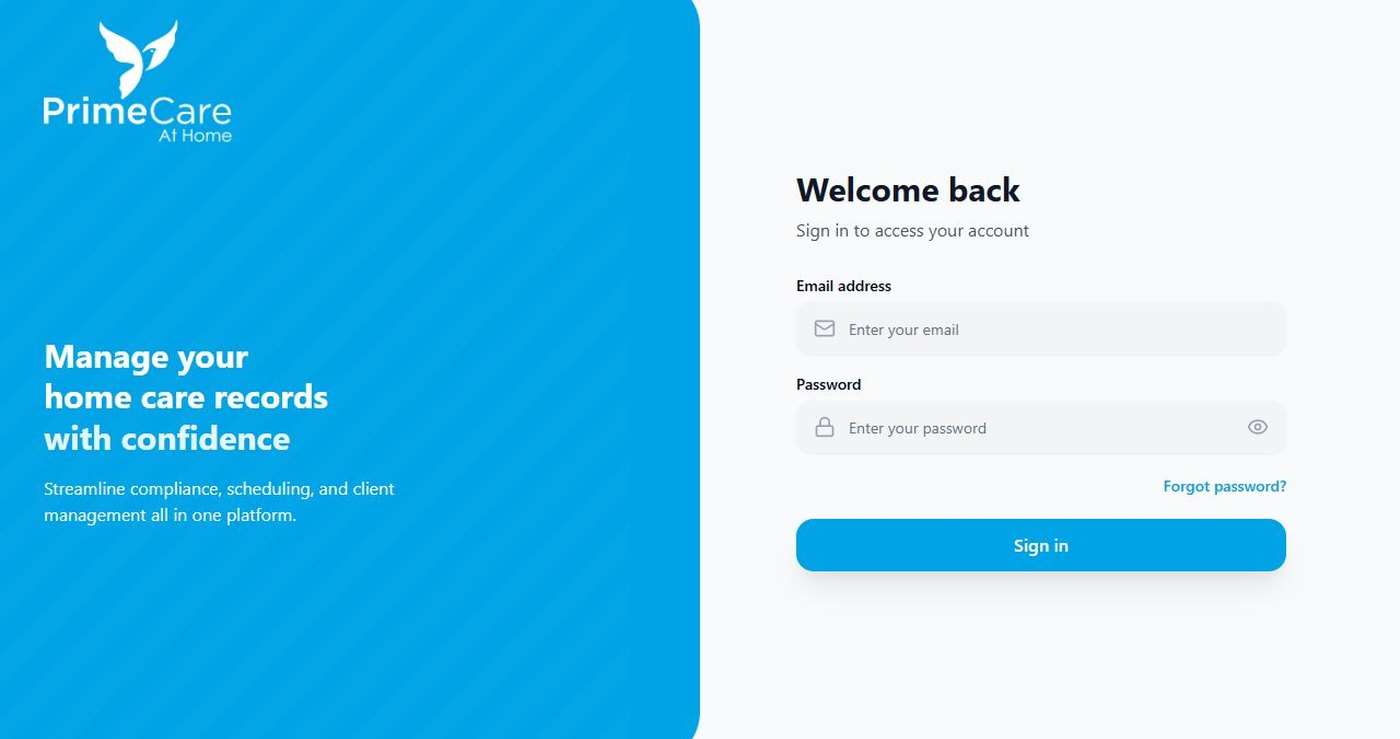
A secure home-care operations platform for caregiver records, patient records, onboarding, document tracking, audit views, and compliance reminders.
PrimeCare needed a cleaner way to manage caregiver files, patient-related records, onboarding paperwork, expiring documents, and audit preparation without relying on paper folders and spreadsheet checks.
The system had to support sensitive home-care operations, role-based access, Department of Health review habits, staged intake, document storage, and staff workflows that could not break during inspection prep.
We built a secure web platform with structured profiles, staged onboarding, compliance status views, OCR-assisted document capture, reminders, auditor access, and admin override controls.
PrimeCare gained a working internal compliance MVP that gives staff one place to review records, spot missing requirements, prepare for audits, and keep improving the workflow in Phase 2.
AWS-hosted web app architecture with secure document storage, role-based access, activity logging, OCR-assisted document workflows, admin dashboards, and compliance-oriented data modeling.
The work moved from an initial operating foundation into ongoing workflow improvements as the care team used the platform and identified the next useful refinements.
PrimeCare started as a paper-heavy home-care compliance problem: physical caregiver files, scattered onboarding documents, manual spreadsheet checks, and inspection prep that depended on staff memory.
We built an internal web platform that turns those workflows into organized digital profiles for office managers, HR coordinators, and compliance officers. The system keeps caregiver and patient records in one place, tracks document status, flags risk, and gives teams a clear picture of what is ready for Department of Health review.
The product is more than storage. It is a role-aware operations dashboard with staged onboarding, compliance scoring, auditor-only access, OCR-assisted document capture, expiration tracking, and room to support additional home-care organizations.
Tab-based profiles organize identification, background checks, health screening, training, legal documents, and linked assignments around the way files are reviewed.
A secure intake flow captures identity details first, then opens the deeper employment paperwork and training steps after the early checks are complete.
Out-of-state IDs are automatically flagged when a caregiver may need an FBI background check in addition to the state-level review.
Green, amber, and red status views help staff spot audit-ready files, missing requirements, expiring items, and blocked profiles without digging through folders.
Admins can grant temporary, read-only inspector access to selected caregiver profiles so reviews stay focused and controlled.
Uploaded IDs and documents can be processed into structured data, making storage cleaner and reducing manual entry work.
The platform tracks expiring certifications, incomplete onboarding steps, CPR, PPD, and annual in-service requirements with reminder logic.
Compliance officers can waive selected internal documents when appropriate without blocking the caregiver approval workflow.
The old inspection-order folders were translated into tabbed profile views so staff and auditors could still find information in the expected order.
Instead of a generic admin panel, the system centers filters, readiness states, document gaps, and restricted inspector views.
Identity verification happens before the full application packet, which helps prevent incomplete records from cluttering the system.
Required documents, optional internal protections, expiration dates, and manual overrides are handled as structured workflow logic.
Instead of spreadsheet checks and paper review, teams can see missing documents, upcoming expirations, and audit readiness from the dashboard.
The build uses AWS-hosted infrastructure, role-based access, secure document storage, and activity logging to support regulated operations.
Send the current process, the records that matter, and the audit or operations pressure your team is trying to solve. We can help turn it into a practical build plan.

Bluegrass Media builds dependable websites, eCommerce experiences, and custom web tools for organizations that need clear communication and reliable execution. adipiscing elit. Maecenas gravida orci id sem aliquet, eu egestas dui ullamcorper. In malesuada urna a suscipit cursus. Class aptent taciti sociosqu ad litora torquent per conubia nostra, per inceptos himenaeos. Proin efficitur nunc a magna blandit pulvinar. Curabitur venenatis id ligula et porttitor. Mauris feugiat interdum arcu, at convallis magna viverra quis. Sed ut urna commodo, laoreet turpis sed, dictum quam.
Vestibulum dignissim risus blandit dolor mollis, in congue orci malesuada. Quisque justo nisl, suscipit eget iaculis quis, rutrum ac massa. In hac habitasse platea dictumst. Aliquam sed velit fermentum, suscipit arcu ut, vulputate libero. Praesent at ultricies nulla. Etiam vitae turpis quis justo tincidunt varius. Quisque vulputate, libero in euismod suscipit, dui ligula viverra nulla, et hendrerit lectus tellus eget tortor. Donec sit amet justo pharetra metus convallis elementum non at lectus. Integer placerat facilisis dui, vel aliquet erat lacinia in. Integer vel metus nec lectus sollicitudin consequat rutrum ut metus. Morbi elementum est orci, vehicula feugiat dolor condimentum ut. Sed sapien sem, tempus eu tempor sit amet, feugiat eu sapien. Etiam non risus sed ipsum tristique posuere. In eget nisi vitae libero congue molestie non quis justo. Curabitur ut auctor leo, varius sollicitudin diam.